sealos.io
AFFiNE
Build production-ready tools templates with Sealos.

https://affine.pro/deploy now
AFFiNE
Tools
A privacy-focused, local-first, open-source workspace for notes, docs, whiteboards, and team knowledge management.

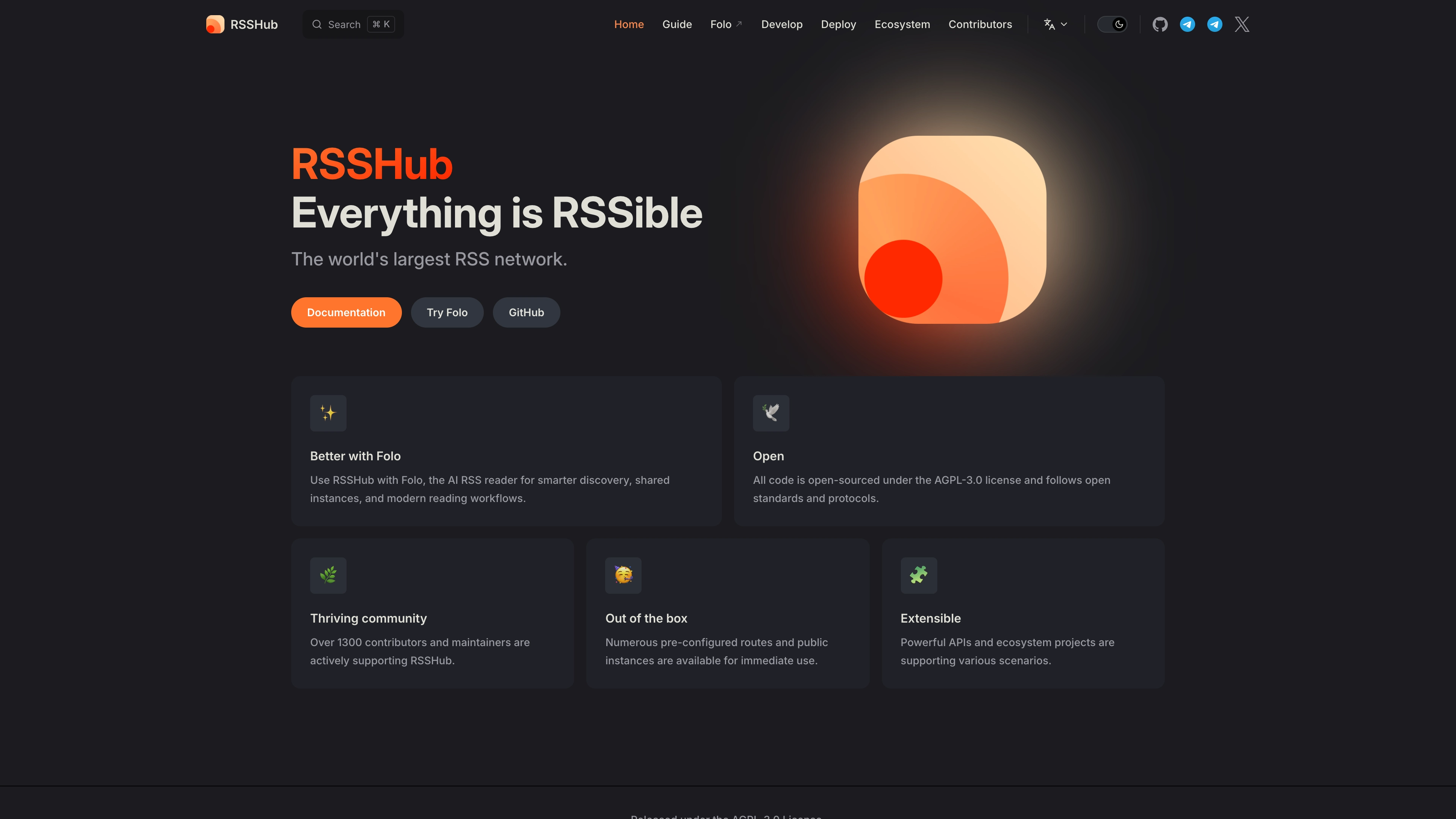
RSSHub converts content from hundreds of websites into standard RSS feeds and provides a public HTTP API for feed readers and automation tools.
Launch in your Sealos workspace.
Start with the resources defined by the RSSHub template. Review CPU, memory, persistent storage, and network allocations for every service in Canvas. Capacity needs depend on your data and workload; monitor usage as they grow.
Template configuration and setupUse the application URL or connection details shown in Canvas. Follow the deployment guide for first-time account setup or client configuration, and keep generated credentials available for that step.
Sealos monthly plans include compute, memory, storage, and traffic. Size your plan for all deployed services. Software licenses and external AI or API services may have separate terms and charges. Confirm the applicable plan and optional charges in Cost Center.
Compare Sealos resource plansFor current cloud charges, refer to Sealos plan pricing. Upstream documentation may reference earlier billing models.
RSSHub converts content from hundreds of websites into standard RSS feeds for feed readers and automation tools. This template deploys RSSHub with Redis caching and a dedicated Browserless service on Sealos Cloud.
RSSHub exposes HTTP routes that collect source content and return RSS output. Feed readers, notification services, and automation systems can subscribe to those routes through the public application URL.
The Sealos template provisions RSSHub, a KubeBlocks Redis service for shared caching, and Browserless Chrome for routes that require browser rendering. Sealos also creates health probes, internal service discovery, a TLS-enabled public endpoint, and persistent Redis storage.
The template includes RSSHub, KubeBlocks Redis, Browserless Chrome, internal Services, health probes, a public Ingress, and the Sealos application entry. The default configuration is ready to deploy without user-provided parameters.
Architecture Components:
2026-07-23 image on port 1200.RSSHub connects to Redis with Sealos-managed database credentials and reaches Browserless through its Playwright WebSocket endpoint. The application, browser service, and database use independently validated resource settings. RSSHub is licensed under the GNU Affero General Public License v3.0.
The root page confirms the RSSHub service is available. Build a feed URL by appending a documented route to the public application URL:
https://<your-rsshub-domain>/<route-and-parameters>
For example, select a route from the RSSHub route catalog, replace the documented https://rsshub.app prefix with your Sealos application URL, and add the resulting URL to a feed reader. The health endpoint is available at /healthz for operational checks.
RSSHub route behavior can be adjusted through supported environment variables on the RSSHub Deployment card. Keep REDIS_URL connected to the included KubeBlocks Redis service and PLAYWRIGHT_WS_ENDPOINT connected to the internal Browserless service.
For deployment changes, use the Sealos Canvas AI dialog or open the RSSHub, Browserless, Redis, and network resource cards directly.
Increase RSSHub CPU and memory for more concurrent or computationally intensive routes. Scale Browserless resources for browser-heavy workloads, and review Redis capacity as cache volume grows. Validate route behavior after every replica or resource change.
Confirm the route path and required parameters against the current route documentation. Review the RSSHub Pod logs for source-site, network, rate-limit, or parsing details.
Confirm that the Browserless Pod is Ready and that its internal Service has an endpoint. Review both RSSHub and Browserless logs for Playwright connection or page-load errors.
Wait for the KubeBlocks Redis Cluster and account Secret to become available. RSSHub connects automatically after the Redis service is ready.
This Sealos template follows the licensing terms of the templates repository. RSSHub is distributed under the GNU Affero General Public License v3.0.
A shorter path from an app you want to an app you can run. Sealos brings deployment and ongoing operations into one place.
Start with a ready-made template. Review its configuration and launch from the Sealos console.
Run on managed infrastructure with built-in workload scheduling and recovery.
Give your application a public HTTPS endpoint with certificates managed for you.
Keep application data on persistent volumes across container restarts.
Adjust CPU, memory, and replicas from the console as your workload changes.
Sealos provisions the resources defined by your template and brings them together in your workspace.
Container workloads with configurable CPU, memory, and replicas.
An address for your app, with managed TLS certificates.
A database provisioned alongside your app when the template calls for one.
Storage for the files and data your application needs to keep.
Application settings and secrets configured in one place.
Inspect container logs and resource usage from the console.
Resources and their configuration vary by template. Review the deployment form for this app’s exact setup.
Explore more production-ready templates.
Build production-ready tools templates with Sealos.
A privacy-focused, local-first, open-source workspace for notes, docs, whiteboards, and team knowledge management.
Build production-ready tools templates with Sealos.

Google Chrome browser running in a LinuxServer.io Selkies container with a web-based desktop UI.
Build production-ready tools templates with Sealos.
Deploy the self-hosted DeeplX translation API on Sealos and connect applications to its HTTP endpoint. This independent gateway integrates with DeepL translation.