sealos.io
AFFiNE
Build production-ready tools templates with Sealos.
https://affine.pro/deploy now
AFFiNE
Tools
A privacy-focused, local-first, open-source workspace for notes, docs, whiteboards, and team knowledge management.

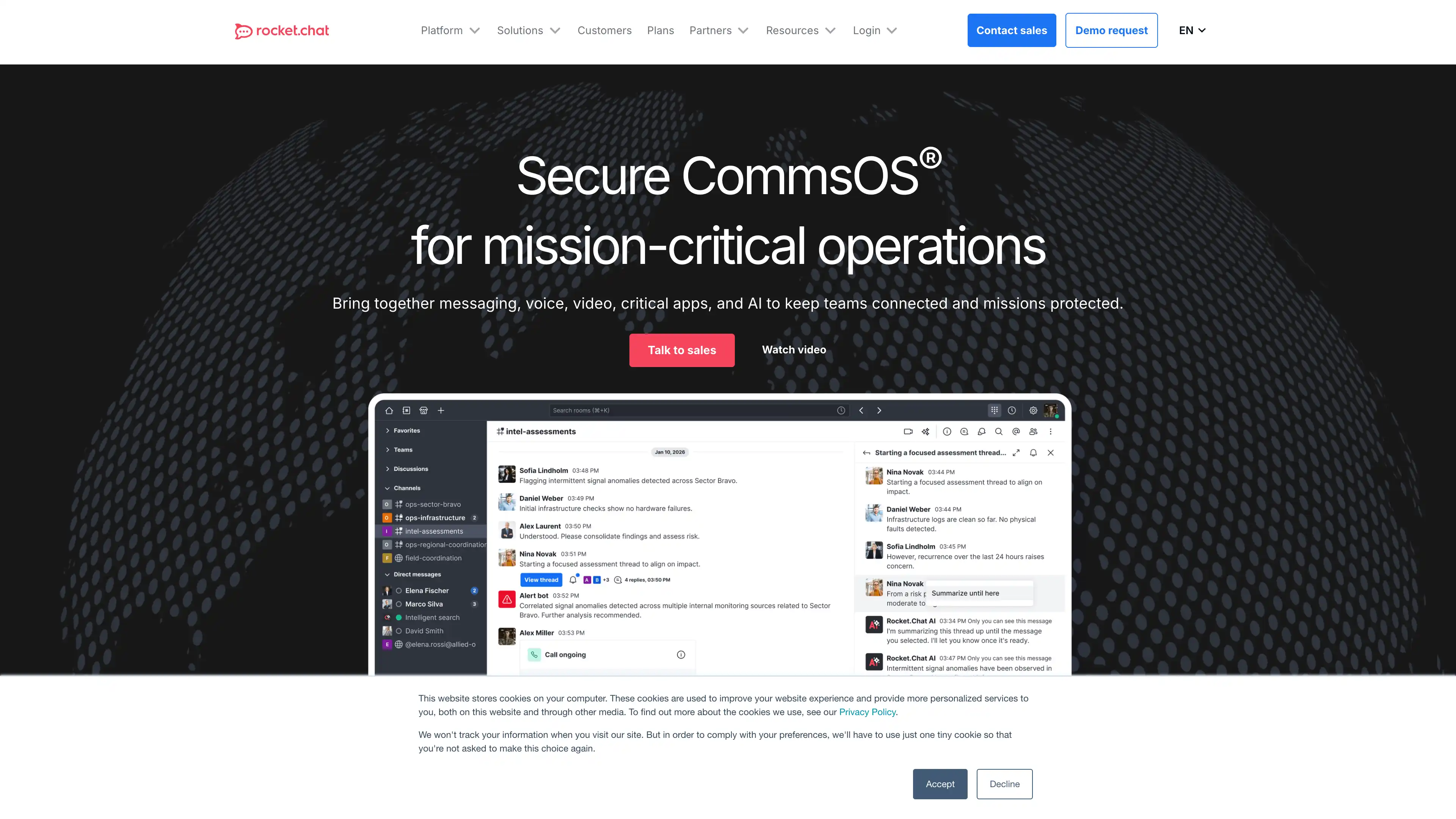
Rocket.Chat is an open-source communications platform for secure team messaging, voice, video, and workflow collaboration.
Launch in your Sealos workspace.
Start with the resources defined by the Rocket.Chat template. Review CPU, memory, persistent storage, and network allocations for every service in Canvas. Capacity needs depend on your data and workload; monitor usage as they grow.
Template configuration and setupUse the application URL or connection details shown in Canvas. Follow the deployment guide for first-time account setup or client configuration, and keep generated credentials available for that step.
Sealos monthly plans include compute, memory, storage, and traffic. Size your plan for all deployed services. Software licenses and external AI or API services may have separate terms and charges. Confirm the applicable plan and optional charges in Cost Center.
Compare Sealos resource plansFor current cloud charges, refer to Sealos plan pricing. Upstream documentation may reference earlier billing models.
Rocket.Chat is an open-source communications platform for private team messaging, channels, file sharing, and workspace administration. This template deploys Rocket.Chat 8.6.1 with a dedicated MongoDB 8.0.4 replica set on Sealos Cloud.
This template deploys the following resources:
enable_s3_storage is enabled and stores uploaded files in a private S3-compatible bucket.The application starts with a tested resource floor of 200 millicores and 2 GiB memory. MongoDB uses 500 millicores and 512 MiB memory. A cold application start typically takes about two minutes after MongoDB becomes ready.
Sealos provisions the Kubernetes runtime, KubeBlocks database, persistent volumes, networking, and optional object storage as part of the deployment.
| Input | Required | Purpose |
|---|---|---|
admin_username | Yes | Username for the initial workspace administrator |
admin_name | Yes | Display name for the initial workspace administrator |
admin_email | Yes | Email address for the initial workspace administrator |
admin_password | Yes | Password for the initial workspace administrator |
enable_s3_storage | No | Creates private Sealos Object Storage for uploaded files; defaults to GridFS |
Use a reachable email address when you plan to connect the workspace to Rocket.Chat Cloud during the setup wizard.
For later changes, use the Canvas AI dialog or open the relevant resource card to adjust configuration and resources.
admin_username and admin_password entered during deployment.Returning administrators use the same username or email address and password. Additional users can use Create account when workspace registration is enabled by the administrator.
GridFS is the default storage mode. Uploaded files are stored inside MongoDB and follow the database lifecycle. This mode is suitable for evaluation and small workspaces.
Enable enable_s3_storage during deployment to create a private S3-compatible bucket. Rocket.Chat receives the bucket endpoint and credentials through Sealos-managed secrets, uses path-style access, and protects file links with short-lived signed URLs. This mode keeps uploaded objects separate from the database and is the recommended option for long-lived workspaces.
Use the Sealos Canvas after deployment to:
Rocket.Chat 8.6.1 uses a mixed license model. Community source outside the enterprise directories is available under the MIT License, while source under apps/meteor/ee/ and ee/ follows the Rocket.Chat Enterprise Edition license. Review the official 8.6.1 license and the applicable subscription terms before production use.
A shorter path from an app you want to an app you can run. Sealos brings deployment and ongoing operations into one place.
Start with a ready-made template. Review its configuration and launch from the Sealos console.
Run on managed infrastructure with built-in workload scheduling and recovery.
Give your application a public HTTPS endpoint with certificates managed for you.
Keep application data on persistent volumes across container restarts.
Adjust CPU, memory, and replicas from the console as your workload changes.
Sealos provisions the resources defined by your template and brings them together in your workspace.
Container workloads with configurable CPU, memory, and replicas.
An address for your app, with managed TLS certificates.
A database provisioned alongside your app when the template calls for one.
Storage for the files and data your application needs to keep.
Application settings and secrets configured in one place.
Inspect container logs and resource usage from the console.
Resources and their configuration vary by template. Review the deployment form for this app’s exact setup.
Explore more production-ready templates.
Build production-ready tools templates with Sealos.
A privacy-focused, local-first, open-source workspace for notes, docs, whiteboards, and team knowledge management.
Build production-ready tools templates with Sealos.

Open-source WhatsApp API platform with Baileys, WhatsApp Cloud API, webhook, chat, bot, and media integrations.
Build production-ready tools templates with Sealos.

Run a remote Firefox browser on Sealos and use its graphical interface from your own browser through noVNC. Keep the browsing session in a hosted container.