sealos.io
AFFiNE
Build production-ready tools templates with Sealos.

https://affine.pro/deploy now
AFFiNE
Tools
A privacy-focused, local-first, open-source workspace for notes, docs, whiteboards, and team knowledge management.

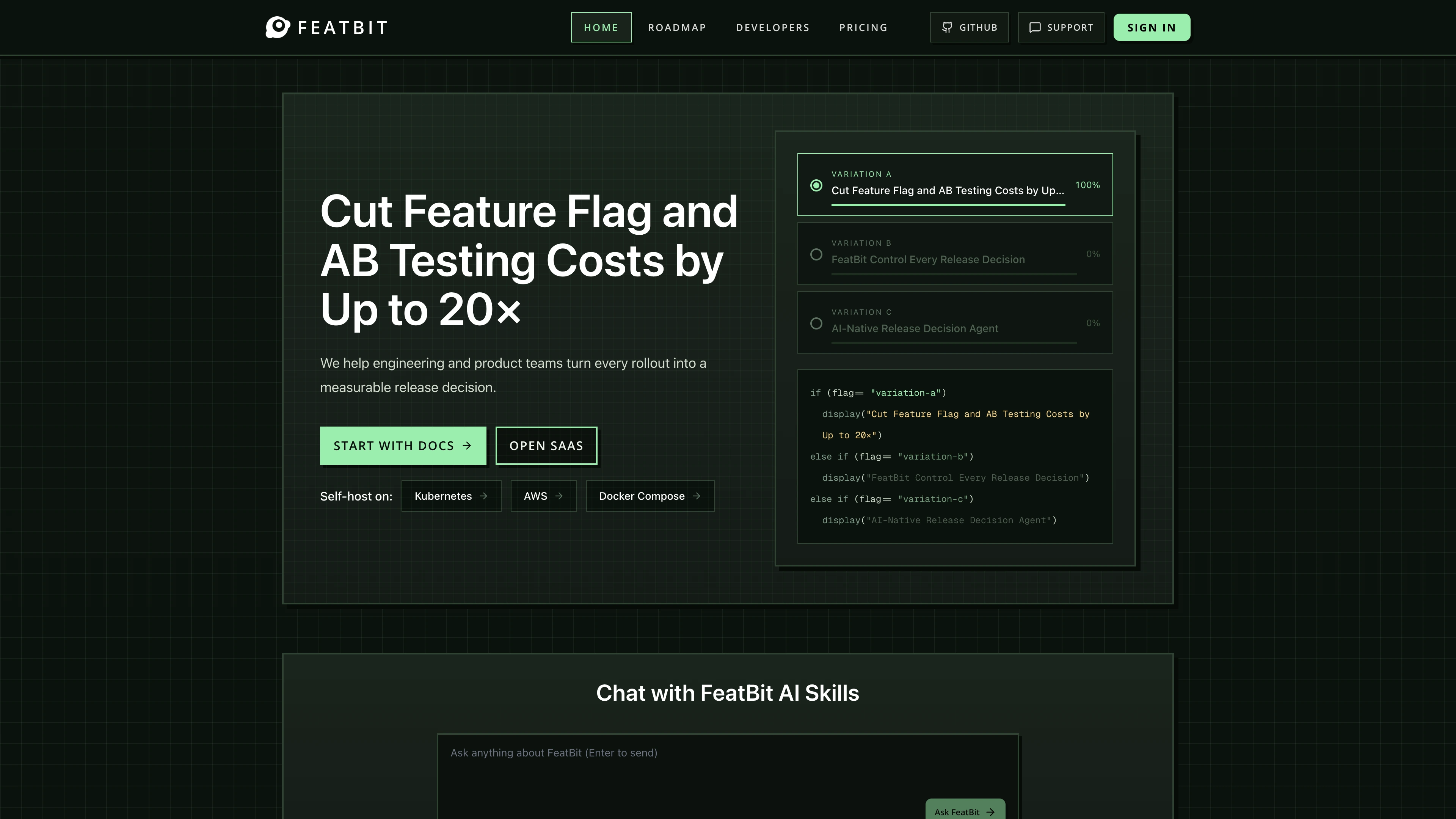
FeatBit is an open-source feature flags management tool that empowers developers (Standard Edition).
Launch in your Sealos workspace.
Start with the resources defined by the FeatBit Standard template. Review CPU, memory, persistent storage, and network allocations for every service in Canvas. Capacity needs depend on your data and workload; monitor usage as they grow.
Template configuration and setupUse the application URL or connection details shown in Canvas. Follow the deployment guide for first-time account setup or client configuration, and keep generated credentials available for that step.
Sealos monthly plans include compute, memory, storage, and traffic. Size your plan for all deployed services. Software licenses and external AI or API services may have separate terms and charges. Confirm the applicable plan and optional charges in Cost Center.
Compare Sealos resource plansFor current cloud charges, refer to Sealos plan pricing. Upstream documentation may reference earlier billing models.
FeatBit Standard is an open-source feature flag and experimentation platform for progressive delivery. This template deploys FeatBit Standard as a multi-service application with PostgreSQL, Redis, public UI, API, and evaluation endpoints on Sealos Cloud.
FeatBit helps teams release features safely by separating deployment from release. Developers can create feature flags, target users or segments, run controlled rollouts, and evaluate changes without redeploying the application.
This Sealos template runs the Standard Edition using four application services: a web UI, an API server, a data analytics server, and an evaluation server. Sealos also provisions PostgreSQL for FeatBit data and Redis for messaging, cache, and runtime coordination.
The template includes automatic public HTTPS endpoints for the UI, API, and evaluation service. Database credentials and service discovery are wired through Sealos-managed Kubernetes resources, so you can deploy the full stack without manually preparing infrastructure.
The Sealos template includes all required runtime dependencies: FeatBit UI, API server, data analytics server, evaluation server, PostgreSQL 16.4, Redis 7.2, Kubernetes Services, Ingress resources, and an initialization Job for the FeatBit database schema.
Architecture Components:
This template deploys the following services:
Configuration:
The template exposes three public endpoints by default: one for the UI, one for the API server, and one for the evaluation server. The UI is configured with the generated API and evaluation URLs during deployment.
PostgreSQL and Redis are created as managed database clusters. The application services receive database host, port, username, and password values from Sealos-managed secrets, while internal services communicate through Kubernetes service discovery.
The application containers are tuned to the smallest validated Sealos resource ladder profile for this template: UI, API, and evaluation services run with 100m CPU and 128Mi memory limits, while the data analytics server runs with 100m CPU and 512Mi memory limits. PostgreSQL and Redis use the database resource profile required by the Sealos database template rules.
License Information:
FeatBit is released as an open-source project. Review the FeatBit repository for the current application license and component-specific notices.
Sealos is an AI-assisted Cloud Operating System built on Kubernetes that unifies the application lifecycle, from development in cloud IDEs to production deployment and management. It is suitable for SaaS platforms, developer tools, and multi-service applications that need managed networking, storage, and operations. By deploying FeatBit Standard on Sealos, you get:
Deploy FeatBit Standard on Sealos and focus on release management instead of infrastructure setup.
After deployment, you can configure FeatBit Standard through:
To scale FeatBit Standard:
For database-related scaling, open the PostgreSQL or Redis resource card and review the available database options before applying changes.
The UI loads but API requests fail
SDK evaluation requests fail
Services wait for database initialization
This Sealos template is provided under the license used by the template repository. FeatBit itself is licensed by the FeatBit project; review the FeatBit GitHub repository for current license details.
A shorter path from an app you want to an app you can run. Sealos brings deployment and ongoing operations into one place.
Start with a ready-made template. Review its configuration and launch from the Sealos console.
Run on managed infrastructure with built-in workload scheduling and recovery.
Give your application a public HTTPS endpoint with certificates managed for you.
Keep application data on persistent volumes across container restarts.
Adjust CPU, memory, and replicas from the console as your workload changes.
Sealos provisions the resources defined by your template and brings them together in your workspace.
Container workloads with configurable CPU, memory, and replicas.
An address for your app, with managed TLS certificates.
A database provisioned alongside your app when the template calls for one.
Storage for the files and data your application needs to keep.
Application settings and secrets configured in one place.
Inspect container logs and resource usage from the console.
Resources and their configuration vary by template. Review the deployment form for this app’s exact setup.
Explore more production-ready templates.
Build production-ready tools templates with Sealos.
A privacy-focused, local-first, open-source workspace for notes, docs, whiteboards, and team knowledge management.
Build production-ready tools templates with Sealos.

Google Chrome browser running in a LinuxServer.io Selkies container with a web-based desktop UI.
Build production-ready tools templates with Sealos.
Deploy the self-hosted DeeplX translation API on Sealos and connect applications to its HTTP endpoint. This independent gateway integrates with DeepL translation.