Deploy Django with PostgreSQL on Sealos
Deploy the protected Django Task Board with PostgreSQL on Sealos using psycopg 3, tasks.0001_initial, migration-first readiness, CSRF writes, restart persistence, and native admin readback.
This second guide keeps the same Django Task Board and replaces local SQLite
with PostgreSQL. The protected
stage-2-postgresql
tag uses Django's PostgreSQL backend, psycopg 3.3.4, one explicit
DATABASE_URL, immutable migration tasks.0001_initial, schema-aware health,
and native administration.
Start with the Stage 1 deployment guide if you still need the plugin, Host adapter, and Runtime Truth workflow. Continue to production after this stage proves migration order and persistence.
Key takeaways
| Question | Verified answer |
|---|---|
| Which connection key does Django read? | DATABASE_URL |
| Which driver opens PostgreSQL connections? | psycopg 3.3.4 |
| Who creates the Task schema? | Django migration tasks.0001_initial |
| What blocks readiness? | Missing configuration, connectivity, or Task table |
| What proves durability? | Process A write, process B read, and admin readback |
Prerequisites
You need:
- The Sealos plugin installed and authenticated
- Git, Python 3.12,
uv,curl, andkubectl - Access to a Sealos workspace that can create application and database resources
- A fresh PostgreSQL database generated by the deployment plan
The protected source harness uses PostgreSQL 17.10. The current installed
Sealos plugin generated a KubeBlocks postgresql-16.4.0 Cluster plan. These
facts have separate authority: 17.10 describes protected-source validation,
and 16.4.0 describes the current Sealos plan generated during practice.
Architecture
PostgreSQL owns durable Task rows. Django owns the rendered board, CSRF form, health contract, and native admin. The migration Job owns schema creation before application readiness.
Step 1: Inspect the database-ready source
Clone the protected stage:
Reproduce the lock and runtime compatibility export:
The accepted source resolves both psycopg and psycopg-binary at 3.3.4.
It selects django.db.backends.dummy while database configuration is absent,
which keeps an unconfigured application in a clear waiting state.
Supply the real connection through the secret boundary:
Apply and inspect the immutable migration:
Require [X] 0001_initial, No changes detected, and the tasks_task columns
completed, id, and title.
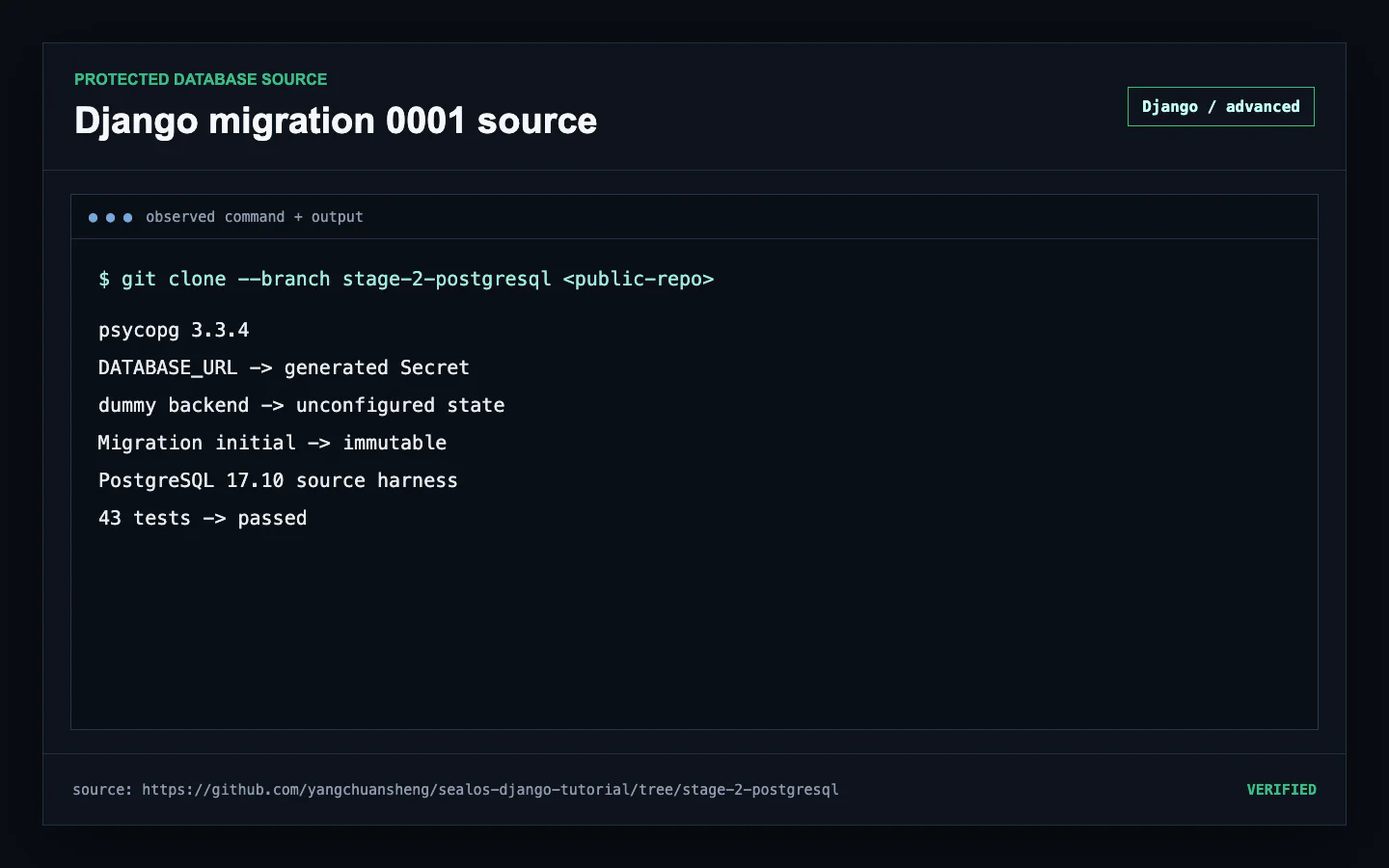 Protected Django Stage 2 source showing psycopg 3.3.4, DATABASE_URL, the dummy waiting backend, and immutable tasks.0001_initial
Step 2: Ask Sealos for Django and PostgreSQL together
From the protected checkout, use Codex CLI:
Or use Claude Code:
The request should produce one resource plan for the board, database, Host adapter, and migration. Review it before DEPLOY so the Secret source, migration order, and public application path remain explicit.
Step 3: Review the generated resource plan
The current installed plugin plan contained these functional parts:
- A Django application workload, Service, HTTPS Ingress, and App resource
- A KubeBlocks PostgreSQL
16.4.0Cluster and generated Service - A generated connection Secret used as the source for
DATABASE_URL - A ConfigMap for protected source or application configuration
- A one-shot Django migration Job
- The upstream
localhostHost contract required by the frozen application
Keep the connection value inside the generated Secret. Review resource names, references, and versions in place while retaining redacted output for review.
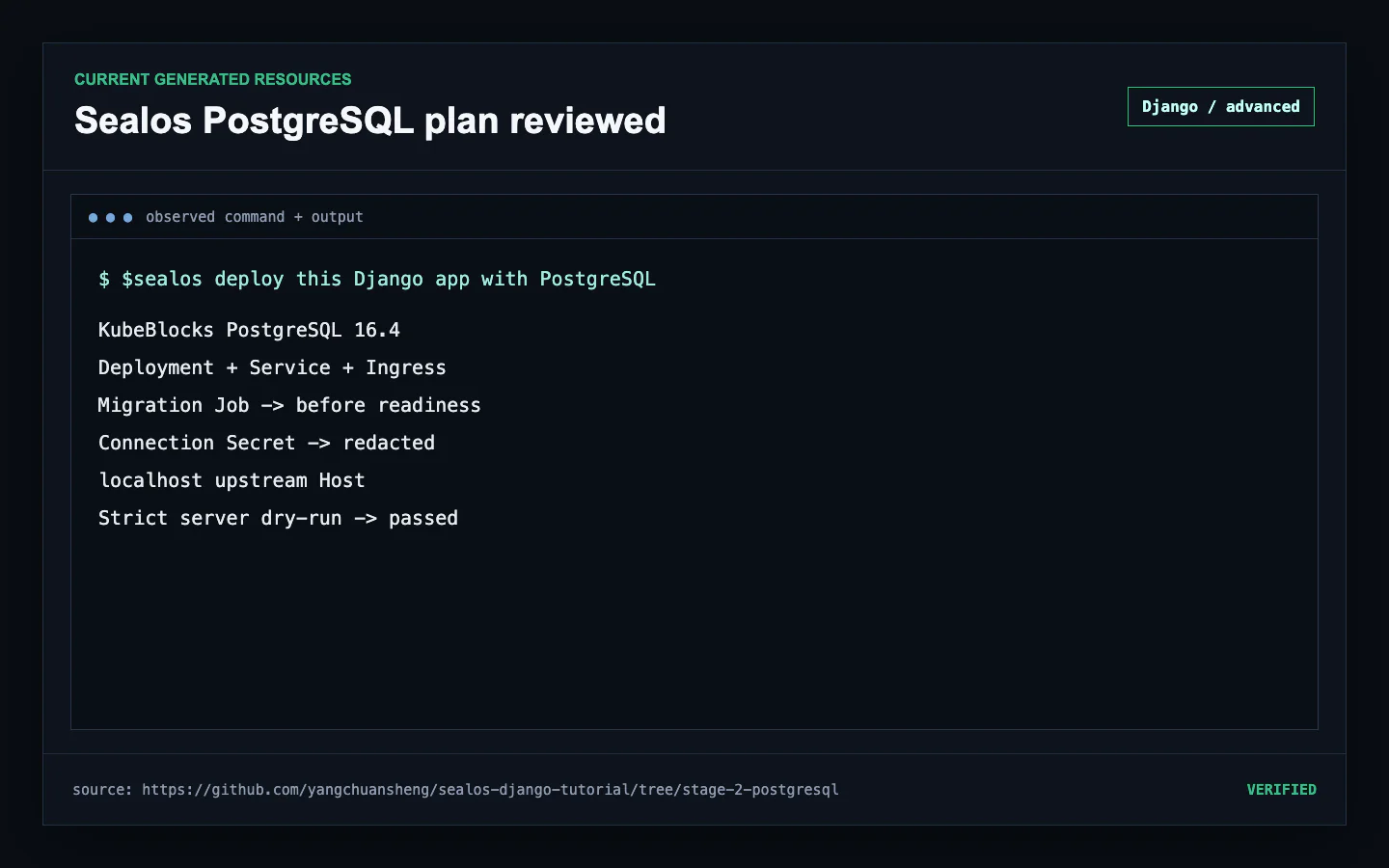 Redacted current Sealos plan for the Django app, KubeBlocks PostgreSQL 16.4, Secret, Service, Ingress, and migration Job
Step 4: Migrate before accepting readiness
The tracked application-image Job reads Secret key url and runs:
Render the protected placeholders, validate the result against the active API, and apply it before the application:
The protected repository also includes a source-projection migration adapter
for pre-image validation. The fresh Phase 27 practice ran that source Job twice
with strict server-side validation. Both runs reported Complete=True and
[X] 0001_initial with the same manifest digest.
Before migration, three public states returned 503 {"status":"unavailable"}:
missing configuration, unreachable PostgreSQL, and a reachable empty schema.
After migration, schema-aware /health returned 200 {"status":"ok"}.
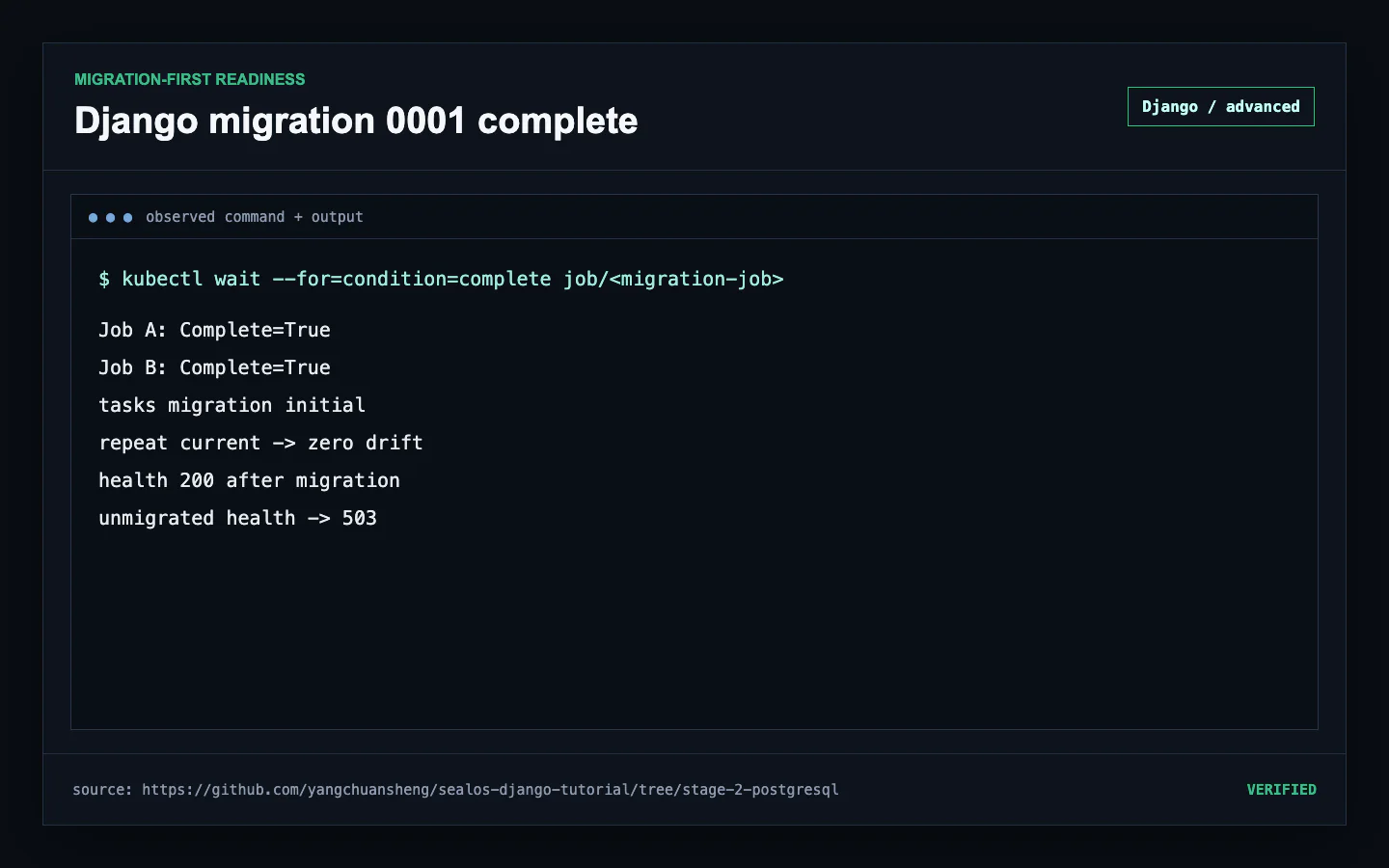 Two strictly validated Django migration Jobs reaching Complete True at tasks.0001_initial before schema-aware health 200
Step 5: Validate the PostgreSQL behavior suite
The protected harness owns temporary PostgreSQL, generated credentials, dynamic loopback ports, migration Jobs, Django processes, and one named browser session:
The accepted current practice completed all 43 PostgreSQL-backed tests after
one bounded local port-forward retry. The database Pod stayed Ready with zero
restarts throughout that retry.
Step 6: Create a Task through the public CSRF form
Check schema-aware health and the board first:
Fetch a mode-0600 cookie jar and the hidden CSRF value, then submit one Task:
The POST uses Django's redirect-after-write flow. A later GET renders the stored row.
Step 7: Prove process-restart persistence
Restart the application workload while retaining the generated PostgreSQL Cluster:
Read the exact title after the replacement process is Ready:
The fresh acceptance used two separately owned Django server processes against
one PostgreSQL database. Process A returned health 200, created the Task, and
stopped and reaped. Process B returned health 200 and rendered the exact
title with 1 task and Open.
Step 8: Verify native admin readback
Create a short-lived administrator through your secret-management path, then open:
Select the created Task and require the change form's title field to match the
public board. The practiced browser loaded both the native changelist and
/admin/tasks/task/1/change/, read the exact title, closed its named session,
and deleted the ephemeral superuser.
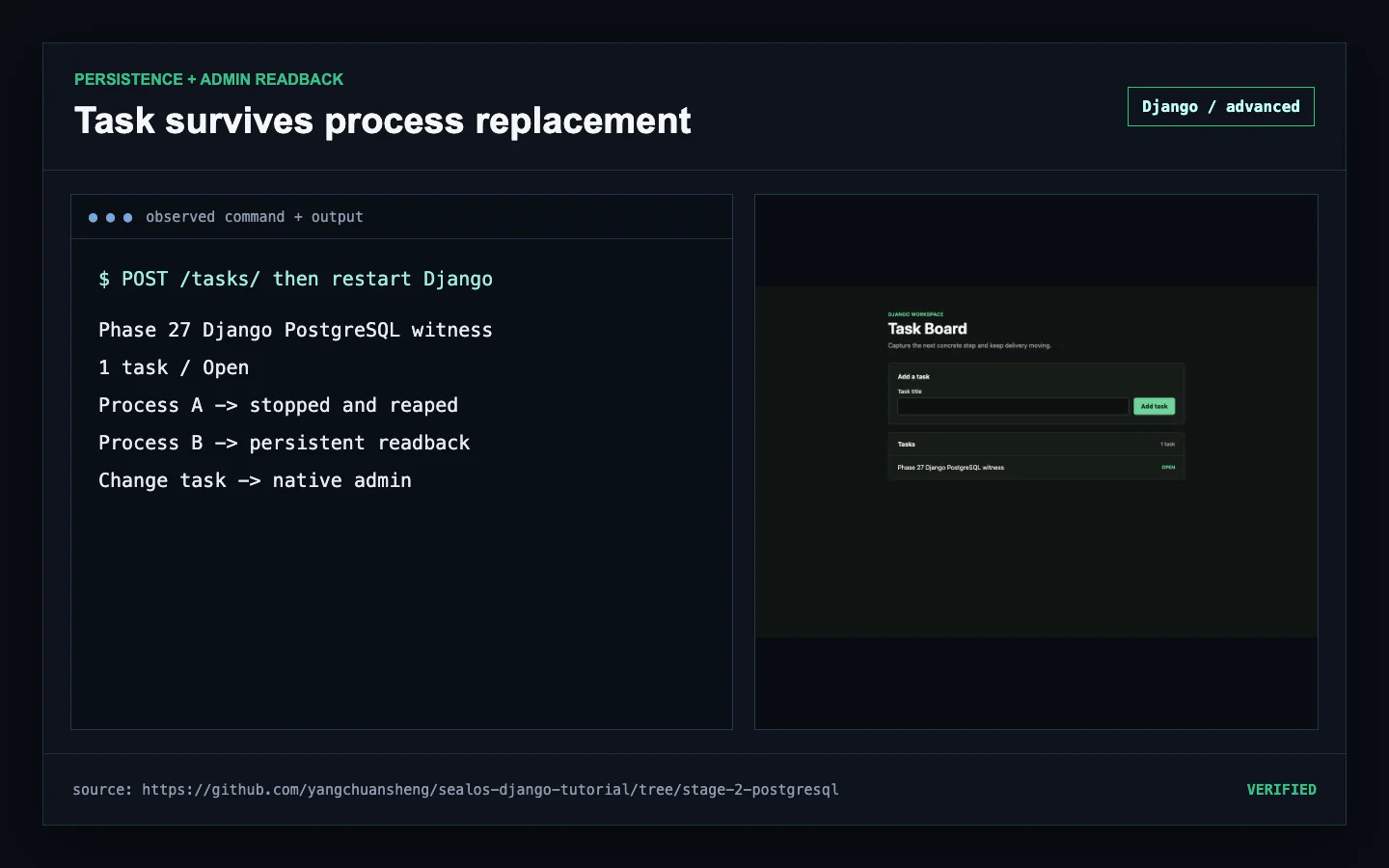 Persistent Django Task visible after process replacement and in the authenticated native admin change form with the account identity redacted
Readiness contract
Use /health as a schema-aware gate:
200 {"status":"ok"}means PostgreSQL is configured, reachable, and migrated.503 {"status":"unavailable"}means configuration, connectivity, or the Task table still needs attention.
Django startup keeps schema ownership explicit. Run and verify the migration Job before accepting readiness or adding replicas.
Common failures
/health stays at 503
Confirm DATABASE_URL comes from the generated Secret, the KubeBlocks Cluster
is Running, and the migration Job is Complete at tasks.0001_initial.
The migration Job cannot connect
Confirm the Job and application consume the same Secret key url. Inspect
references by name and key while keeping the value in the secret boundary.
Public Task creation returns 403
Fetch a fresh cookie and CSRF token from the same public host. Preserve the
browser-facing origin while the run-owned edge sends Django's trusted
localhost Host, Origin, and Referer upstream.
Tasks disappear after restart
Confirm the replacement process reads the same generated DATABASE_URL and
that the PostgreSQL Cluster remained in place through the rollout.
Completion checklist
- The checkout points at protected
stage-2-postgresql - Lock reproduction and runtime export checks pass
- psycopg
3.3.4andDATABASE_URLmatch protected source - The plan contains app, PostgreSQL, Secret, Service, Ingress, and Job resources
- The generated PostgreSQL version is reviewed as current plan truth
- Two migration Job runs report
Complete=Trueattasks.0001_initial - Schema-aware
/healthreturns200 - All 43 PostgreSQL-backed tests pass
- A CSRF-protected Task survives application process replacement
- Native admin reads the same title and the ephemeral account is removed
- Runtime resources, sessions, and scratch pass exact cleanup
Continue with Django Production Deployment on Sealos for immutable images, hardened Gunicorn replicas, WhiteNoise, release logs, and rollback recovery.
FAQ
Keep building
Continue this Sealos path
 Sealos
Unify Your Entire Workflow.
Code in a ready-to-use cloud environment, deploy with a click. Sealos combines the entire dev-to-prod lifecycle into one seamless platform. No more context switching.


Explore with AI
Get AI insights on this article