sealos.io
Chrome
Build production-ready tools templates with Sealos.

https://www.google.com/chrome/deploy now
Chrome
Tools
Google Chrome browser running in a LinuxServer.io Selkies container with a web-based desktop UI.
Open-source backend platform for building applications with authentication, databases, storage, functions, and APIs.
Launch in your Sealos workspace.
Start with the resources defined by the Appwrite template. Review CPU, memory, persistent storage, and network allocations for every service in Canvas. Capacity needs depend on your data and workload; monitor usage as they grow.
Template configuration and setupUse the application URL or connection details shown in Canvas. Follow the deployment guide for first-time account setup or client configuration, and keep generated credentials available for that step.
Sealos monthly plans include compute, memory, storage, and traffic. Size your plan for all deployed services. Software licenses and external AI or API services may have separate terms and charges. Confirm the applicable plan and optional charges in Cost Center.
Compare Sealos resource plansFor current cloud charges, refer to Sealos plan pricing. Upstream documentation may reference earlier billing models.
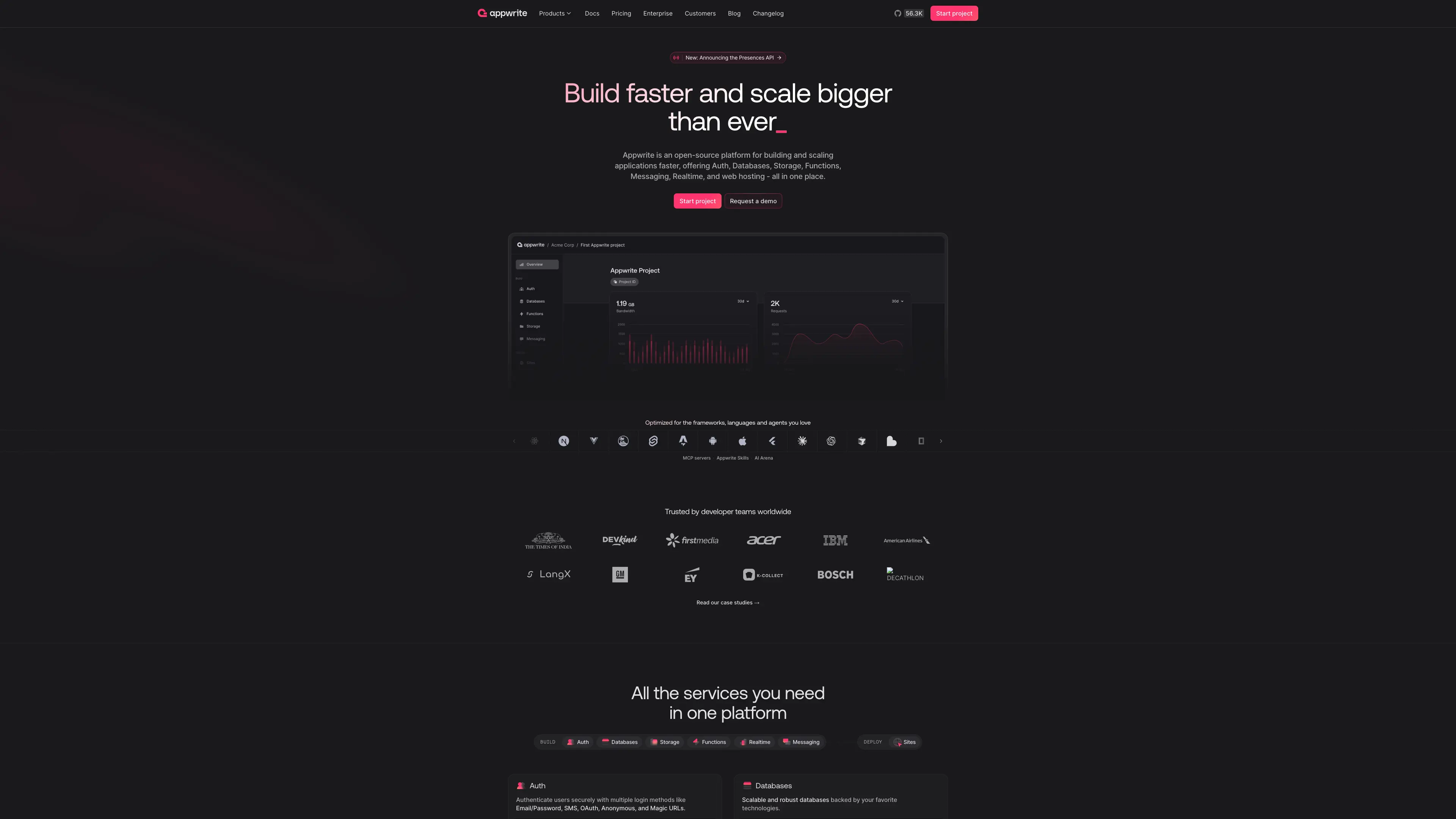
Appwrite is an open-source backend platform for building applications with authentication, databases, storage, functions, and APIs. This template deploys Appwrite 1.9.0 with MongoDB, Redis, persistent storage, optional S3-compatible object storage, and HTTPS ingress on Sealos Cloud.
Appwrite provides a self-hosted backend console and API for projects that need user authentication, document databases, file storage, serverless-style functions, and platform services behind a single API surface.
This Sealos template provisions the core Appwrite web/API service, KubeBlocks-managed MongoDB and Redis clusters, persistent /storage, and a public HTTPS URL. The template also includes an optional Sealos S3-compatible object storage bucket for user uploads.
The Sealos template includes Appwrite, MongoDB, Redis, persistent storage, optional object storage, a Service, an Ingress, and an App launcher entry.
80/storage| Component | CPU Request | CPU Limit | Memory Request | Memory Limit |
|---|---|---|---|---|
| Appwrite | 20m | 200m | 25Mi | 256Mi |
| MongoDB | 50m | 500m | 51Mi | 512Mi |
| Redis | 50m | 500m | 51Mi | 512Mi |
| Redis Sentinel | 50m | 500m | 51Mi | 512Mi |
Sealos generates the public hostname, application name, OpenSSL key, and executor secret automatically. MongoDB and Redis credentials are injected from KubeBlocks-managed secrets. Appwrite router protection is disabled so both Sealos ingress traffic and internal Kubernetes health checks can reach the service.
Appwrite is licensed under the BSD 3-Clause License. This template follows the licensing terms of the Sealos templates repository.
Sealos is an AI-assisted Cloud Operating System built on Kubernetes that simplifies the full deployment lifecycle. By deploying Appwrite on Sealos, you get:
After deployment, use the Sealos Canvas to adjust CPU, memory, storage, or the public hostname. Use the Appwrite Console for project-level configuration, authentication providers, database collections, storage buckets, API keys, and platform settings.
This template is optimized for a single Appwrite web/API instance. Scale vertically first by increasing CPU and memory on the Appwrite StatefulSet. Increase MongoDB, Redis, or storage capacity as project data grows.
Issue: Appwrite takes several minutes to become ready
Issue: Uploads should use object storage
This Sealos template follows the licensing policy of the templates repository. Appwrite itself is licensed under the BSD 3-Clause License.
A shorter path from an app you want to an app you can run. Sealos brings deployment and ongoing operations into one place.
Start with a ready-made template. Review its configuration and launch from the Sealos console.
Run on managed infrastructure with built-in workload scheduling and recovery.
Give your application a public HTTPS endpoint with certificates managed for you.
Keep application data on persistent volumes across container restarts.
Adjust CPU, memory, and replicas from the console as your workload changes.
Sealos provisions the resources defined by your template and brings them together in your workspace.
Container workloads with configurable CPU, memory, and replicas.
An address for your app, with managed TLS certificates.
A database provisioned alongside your app when the template calls for one.
Storage for the files and data your application needs to keep.
Application settings and secrets configured in one place.
Inspect container logs and resource usage from the console.
Resources and their configuration vary by template. Review the deployment form for this app’s exact setup.
Explore more production-ready templates.
Build production-ready tools templates with Sealos.
Google Chrome browser running in a LinuxServer.io Selkies container with a web-based desktop UI.
Build production-ready tools templates with Sealos.
A privacy-focused, local-first, open-source workspace for notes, docs, whiteboards, and team knowledge management.
Build production-ready tools templates with Sealos.

Run a remote Firefox browser on Sealos and use its graphical interface from your own browser through noVNC. Keep the browsing session in a hosted container.